If you are paying for Google Ads, Meta Ads, TikTok Ads or LinkedIn Ads, your landing page is where the money is either recovered or wasted. The ad gets the click. The landing page gets the lead.
This guide explains how UK small businesses can design landing pages that feel trustworthy, load quickly, match the campaign message and convert more visitors into calls, bookings, quote requests and sales.
page, one audience, one conversion goal
speed and usability matter heavily for paid traffic
proof must appear before the visitor hesitates
average documented ecommerce cart abandonment rate
Why Landing Page Design Matters More Than Most Businesses Think
A lot of small businesses spend money on ads before fixing the page the ads send people to. That is backwards. If the landing page is slow, vague, untrustworthy or too generic, increasing the ad budget simply increases wasted spend.
A strong landing page is not just a pretty design. It is a sales journey. It matches the visitor's search, proves the business can help, answers objections and makes the next step easy.
The ad creates intent
Your campaign promises a solution and attracts the right visitor.
The page earns trust
The landing page confirms the visitor is in the right place and removes doubt.
The CTA captures demand
The visitor knows exactly what to do next and why it is worth doing now.
Homepage vs Landing Page: What Is the Difference?
Your homepage introduces the whole business. A landing page sells one specific offer to one specific audience. That difference changes the design, copy, layout and conversion strategy.
Broad introduction
- Explains the whole business
- Links to multiple services
- Serves different visitor types
- Supports brand discovery and navigation
- Useful for organic visitors and existing customers
Focused conversion page
- Matches one campaign or search intent
- Promotes one offer or outcome
- Targets one type of buyer
- Removes distracting links where possible
- Designed to convert paid traffic efficiently
The High-Converting Landing Page Blueprint
A landing page should not be a random collection of sections. It should answer the visitor's questions in the order they naturally appear.
Hero section: confirm the promise immediately
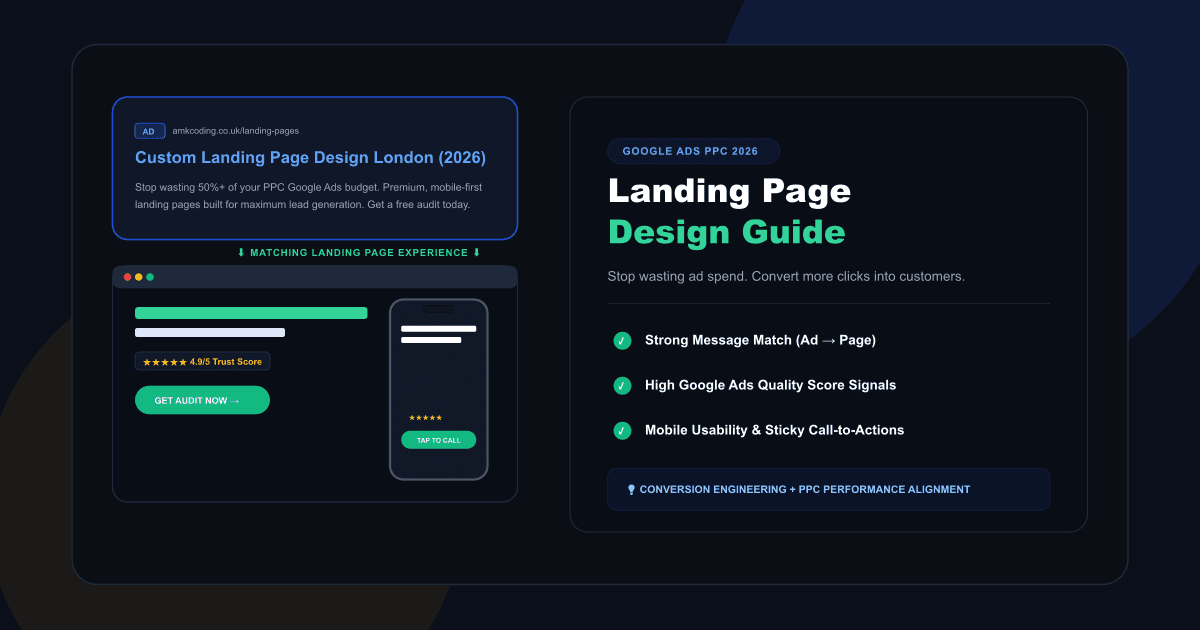
The first screen should match the ad or search query. If the ad says "Web Design for UK Service Businesses", the landing page headline should not say "We Build Digital Experiences". Message match builds confidence.
Award-winning digital solutions for modern brands.
Landing page design for UK small businesses running paid ads.
Primary CTA: make the next step obvious
Your call to action should be specific and repeated throughout the page. Avoid weak labels like "Submit" or "Learn more" when the goal is commercial intent. Use action-led text that tells people what they get.
Problem and outcome: show you understand the buyer
A visitor should feel understood before they are sold to. Explain the pain clearly: wasted ad spend, low enquiry quality, slow pages, weak trust, poor mobile experience or unclear offer. Then show the better outcome your solution creates.
Trust block: prove it before asking for action
Visitors need evidence. Add real reviews, case studies, project screenshots, client logos, before-and-after examples, accreditations, guarantees or transparent process steps. Do not hide all your proof at the bottom of the page.
Offer section: make the value easy to compare
If the page is promoting a service, explain what is included. If it is promoting a product, explain the product benefits, delivery, warranty and returns. If it is promoting a consultation, explain what happens after the visitor books.
- What the visitor gets
- Who it is best for
- How long it takes
- What happens after enquiry
Objection handling: answer the doubts before they leave
People rarely convert while still confused. Use sections and FAQs to answer concerns about price, timing, process, contract length, technical setup, support, payment, guarantees and suitability.
Simple form: ask only for what you need
Long forms can reduce enquiries, especially on mobile. For most service businesses, start with name, email, phone and a short message. You can collect deeper details after the first contact.
Budget, company size, full address, project deadline, how did you hear about us, 12 required fields.
Name, email, phone, what do you need help with?
Designing for Google Ads Landing Page Experience
If the landing page is used for Google Ads, design decisions affect more than conversion rate. Google Ads also evaluates landing page experience. That means the page should be relevant, useful, transparent, mobile-friendly and fast.
| Factor | What it means | Design action |
|---|---|---|
| Relevance | The page matches the ad, keyword and search intent | Use the same offer language in the headline and first section |
| Usefulness | The page helps the visitor make a decision | Add benefits, proof, pricing guidance, process and FAQs |
| Transparency | The visitor understands who you are and what happens next | Show company details, contact information, terms and privacy links |
| Mobile usability | The page works well on phones | Use large buttons, short forms, readable text and sticky CTAs carefully |
| Speed | The page loads quickly and responds smoothly | Optimise images, scripts, fonts, LCP, INP and CLS |
A Simple Landing Page Wireframe That Works
You do not need to reinvent the layout every time. Start with this structure and adapt it to the offer, audience and traffic source.
Headline, subheadline, CTA, trust micro-proof.
Show the pain the visitor already recognises.
Explain the offer and the outcome clearly.
Reviews, screenshots, case studies or real results.
Make the next steps feel safe and predictable.
Show what is included and who it is for.
Answer price, timing, support and risk objections.
Repeat the main action with confidence.
Landing Page Mistakes That Waste Ad Spend
These mistakes are common because they look harmless. In reality, they can quietly reduce conversion rate and make every click more expensive.
Sending every campaign to the homepage
Your homepage is too broad for most paid traffic. Campaign-specific landing pages usually match intent better.
Using a clever headline instead of a clear one
Visitors should not need to decode what you do. Clarity beats cleverness when someone has clicked with intent.
Hiding proof too low down the page
Reviews, case studies and trust signals should appear before the visitor feels risk.
Making mobile forms painful
Too many fields, tiny inputs and unclear labels can lose leads that were already interested.
Ignoring page speed
Heavy videos, large images and unnecessary scripts can make paid visitors leave before the page is useful.
Not tracking the right conversions
A good landing page needs measurement: form submissions, phone clicks, booking starts, purchases and qualified leads.
A Landing Page Is Not Finished Until Tracking Works
Design without tracking is guesswork. Before sending paid traffic, make sure the page records the actions that matter to the business.
- Form submissions
- Phone number clicks
- Booking button clicks
- Checkout starts and purchases
- Scroll depth and CTA engagement
- Qualified lead quality after the enquiry
Landing Page Design Checklist
Use this before launching a paid campaign. If several items are missing, the page is probably not ready for traffic.
| Priority | Check | Why it matters |
|---|---|---|
| Critical | Headline matches the ad or keyword | Confirms the visitor is in the right place |
| Critical | Primary CTA visible above the fold | Makes the next action obvious |
| Critical | Page loads quickly on mobile | Protects paid traffic from avoidable drop-off |
| High | Reviews or proof appear early | Builds trust before the ask |
| High | Form asks only for essential details | Reduces friction, especially on phones |
| High | FAQs answer price, timing and process doubts | Prevents avoidable hesitation |
| Medium | Company details and privacy links are visible | Improves transparency and trust |
| Medium | Tracking events are tested before launch | Lets you measure what actually works |
Related AMK Coding Guides
Frequently Asked Questions
What is a landing page?+
Do I need a landing page for Google Ads?+
What makes a landing page convert well?+
How long should a landing page be?+
How much does landing page design cost in the UK?+
Sources and Further Reading
- Google Ads Help — Evaluate the performance of your landing pages.
- Google Search Central — Core Web Vitals and Google Search results.
- web.dev — Interaction to Next Paint becoming a Core Web Vital.
- Google Search Central — Mobile-first indexing best practices.
- Baymard Institute — Cart and checkout usability research.
Want a Landing Page That Turns Clicks into Leads?
AMK Coding designs landing pages for UK businesses that need clearer messaging, stronger trust, faster load times and better conversion from paid traffic. We can audit your current page or build a focused campaign page from scratch.
AMK Coding • Landing Page Design • Google Ads Pages • Built for Leads
AMK Coding
AMK Coding (trading as PEOPLELY LTD) is a UK web development and digital product studio. We build websites, landing pages, ecommerce experiences and custom platforms with SEO, speed, mobile usability and conversion strategy built into the foundations.