Most web agencies respond to the question “how much does a website cost?” with “it depends.” That is an unhelpful, evasive non-answer. This guide gives you real, honest numbers — the actual UK market rates in 2026, broken down by what you are building, who is building it, and what it costs to keep running after launch.
There are 5.7 million private sector businesses in the UK. Around 27% of small businesses still do not have a website at all — and of those that do, many have sites that are not doing meaningful work for the business. In 2026, the gap between a website that generates leads and one that merely exists has never been wider. The right question is not “how little can I spend?” It is “what is the minimum investment that gives me a high-performance, search-optimised website capable of ranking on Google, loading fast enough to hold visitors, and converting them into enquiries? That number is higher than most business owners expect — and lower than most legacy London agencies would have you believe.
In This Pricing Guide:
What Actually Drives the Price
Website costs are not random. They are driven by four concrete variables. Once you understand them, any quote you receive becomes instantly interpretable.
- →
Scope: Number of pages, whether there is a blog, product listings, booking systems, member areas, or custom integrations. A 5-page brochure site and a 200-product online shop are completely different projects.
- →
Design approach: Template-based (layout is pre-built, designer customises colours and content) versus fully custom (everything is designed from scratch for your brand). Custom design costs more and takes longer — but it is the only way to build something that genuinely differentiates you.
- →
Who builds it: DIY builder, offshore freelancer, domestic freelancer, small agency, large London agency. Each tier has different cost, quality, reliability, and support implications.
- →
What's included: Does the quote cover copywriting? SEO setup? Hosting configuration? Photography? Training? Most cheap quotes assume you supply everything except the code.
Cost by Who Builds It
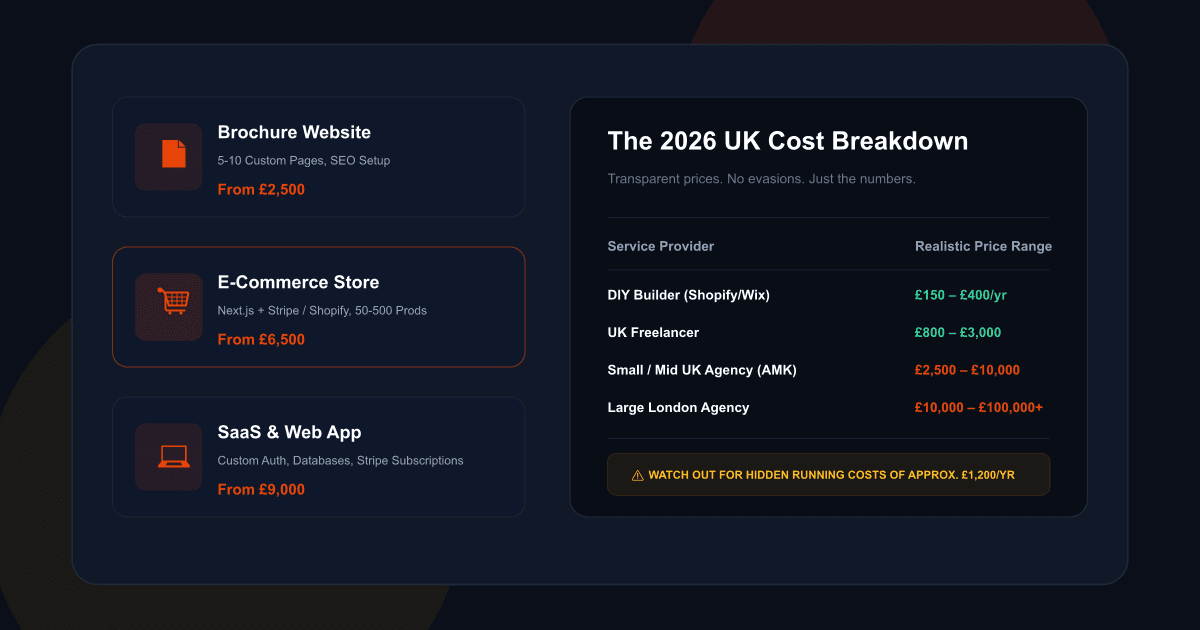
The provider you choose has a bigger impact on cost than almost any other variable. Here is how each tier compares in the 2026 UK market.
DIY Website Builders (Wix, Squarespace, Shopify)
£150–£400/yr- ✓ Online presence within days
- ✓ Mobile-friendly templates
- ✓ Built-in hosting and security
- ✓ Basic e-commerce capabilities
- ✕ Custom design or unique branding
- ✕ Technical SEO control and custom schemas
- ✕ Competitive speed scores
- ✕ Complete ownership of code and data
Domestic Freelancer (UK-Based)
£800–£3,000- ✓ Custom design and implementation
- ✓ Direct developer communication
- ✓ Affordable entry pricing
- ✓ High flexibility on smaller updates
- ! Single point of failure (illness, busy periods)
- ! No standard SEO structure or copy writing
- ! Ongoing maintenance agreements can be patchy
- ! Highly varied design/coding standard
Small / Mid-Size UK Agency (AMK Coding tier)
£2,500–£10,000- ✓ Full dedicated team (designer, dev, strategist)
- ✓ Structured process, timelines, and testing
- ✓ Dedicated ongoing maintenance and SLAs
- ✓ Technical SEO, schema markup, speed optimized
- • Higher upfront budget than standard freelancer
- • Requires 4-8 weeks process structure
Large London Agency
£10,000–£100,000+- ✓ Enterprise-grade account & project managers
- ✓ Large-scale brand specialists across divisions
- ✓ In-person high-end boardroom presentations
- ✕ Premium central London office rents & overheads
- ✕ Double/triple markups for the same core tech frameworks
- ✕ Junior staff often doing the actual dev work
Cost by Website Type
Who builds it matters — but what you are building matters more. Here is how UK agency pricing breaks down by the category of site in 2026.
| Website Type | Typical Agency Cost | Timeline | Key Platform |
|---|---|---|---|
| 1-page / Landing page | £800–£2,500 | 1–2 weeks | Next.js, Tailwind, HTML |
| Brochure site (5–10 pages) | £2,000–£5,000 | 4–6 weeks | Next.js, WordPress |
| Lead generation site | £3,000–£7,000 | 6–8 weeks | Next.js, WordPress |
| Private clinic / Healthcare | £3,500–£8,000 | 6–10 weeks | Next.js (CQC-aware build) |
| E-Commerce (50–500 products) | £5,000–£20,000 | 8–14 weeks | Next.js + Stripe / Shopify |
| E-Commerce (500+ products) | £15,000–£50,000+ | 12–24 weeks | Next.js headless / Shopify Plus |
| SaaS / Web application | £8,000–£40,000+ | 12–24 weeks | Next.js + Supabase / custom DB |
| Marketplace or Directory | £20,000–£100,000+ | 20–52 weeks | Custom full-stack |
What a Cheap Website Actually Costs You
This is the section most pricing guides skip, because it is uncomfortable. A website that costs £400 on a DIY builder but generates zero organic traffic and converts 0.5% of visitors is not cheaper than a £4,000 professionally built site that ranks on page one and converts 4%.
Consider a local service business — a plumber, a physio, a solicitor — getting 500 visitors per month from Google. The difference between a 0.5% and a 4% conversion rate is 17.5 additional enquiries per month. At even a modest £200 average job value, that is £3,500/month in additional revenue. The professionally built site pays for itself in the first month of operation.
The real cost of a cheap website is not the build price. It is the compounding monthly revenue you do not generate because your site does not rank, does not load fast enough, and does not convince visitors to contact you. If your project is closer to a product than a brochure, see our web and mobile app development services for SaaS, custom software, and cross-platform apps.
The Right Questions to Ask Before Signing a Quote
Before you commit to any web agency or freelancer in the UK, these are the questions that separate a sound investment from a costly mistake:
- →
“Is this price ex-VAT or inc-VAT?” A £3,000 quote becomes £3,600 with VAT added. Always clarify upfront.
- →
“What platform will this be built on, and do I own it outright?” Some agencies lock you into proprietary CMSes you cannot take elsewhere.
- →
“What are the hosting costs after year one?” Get this in writing before signing.
- →
“Is SEO setup included — meta tags, sitemap, Google Search Console?” The majority of cheap builds include nothing SEO-related.
- →
“Who will update the site after launch, and what does that cost?” If you cannot update it yourself, budget for a maintenance retainer.
- →
“Can I see examples of sites you've built in my industry?” Portfolio quality matters enormously — ask specifically for live URLs, not static design mockups.
- →
“What is your process if something breaks after launch?” Response time guarantees should be in writing.
AMK Coding — What We Charge and What You Get
We are a Brighton-based agency serving London and the UK. We build on Next.js and React for performance-first sites, and on WordPress where a non-technical CMS is genuinely the right fit. We are transparent about pricing — here is what our typical projects cost in 2026.
| Project Type | Starting From | What's Included | Timeline |
|---|---|---|---|
| Brochure / Small business site | £2,500 | Custom design, mobile-first build, basic SEO setup, Google Search Console, 1 month post-launch support | 4–6 weeks |
| Lead generation site | £3,500 | All above + conversion-optimised CTAs, advanced forms, CRM integration, Core Web Vitals optimized | 6–8 weeks |
| Private clinic / Healthcare | £4,000 | CQC-aware trust signals, secure booking integrations, fully GDPR-compliant forms, YMYL structures | 6–10 weeks |
| E-commerce (Next.js + Stripe) | £6,500 | Custom product layouts, fast cart, secure Stripe billing APIs, automated invoice emails, inventory panel | 8–14 weeks |
| SaaS / Web application | £9,000 | Secure auth, DB architecture, Stripe subscriptions, dashboard UI, API webhooks, robust deploy pipeline | 12–20 weeks |
| Website redesign / Migration | £2,000 | Full modern rebuild with SEO equity preservation, redirect maps (301), modern responsive UX transition | 4–8 weeks |
All our projects include a fixed-price proposal upfront — no surprises on the final invoice. We tell you what we cannot include in the scope before the project starts, not after. Ongoing maintenance retainers start from £150/month and cover updates, security, performance monitoring, and up to two hours of content changes per month.
Get a Fixed-Price Quote for Your Project
Tell us what you need in a 30-minute call. We'll give you a clear scope and a fixed price — no hourly rate ambiguity, no creeping costs, no surprises. If we're not the right fit, we'll tell you that too.
AMK Coding • Brighton-based, serving London & the UK • Next.js & WordPress specialists • Fixed-price proposals
Frequently Asked Questions
How much does a small business website cost in the UK in 2026?+
What are the ongoing costs of running a website in the UK?+
Why do web design quotes vary so much in the UK?+
Is a cheap website worth it for a UK business?+
How long does it take to build a website in the UK?+
Sources & Official Guidelines
- UK Government (GOV.UK) — VAT charging and compliance rules for business invoicing and thresholds.
- W3C Web Accessibility Initiative (WAI) — Web Content Accessibility Guidelines (WCAG) for modern small business websites.
- BrightLocal — Local Consumer Trust & Business Reviews Index.
- Vercel — Total Cost of Ownership (TCO) benchmarks for serverless and headless platforms.