If you are running a growing e-commerce brand in the UK right now, you have almost certainly had this conversation: someone suggests moving off WordPress. Or staying on it. Either way, the argument gets messy fast, because both sides have legitimate points — and most comparison articles are written by developers who have only actually built on one of them.
At AMK Coding, we build on both. We deliver high-performing WooCommerce e-commerce sites for clients where it genuinely makes sense, and headless Next.js solutions for clients where performance, security, or global scalability make it the better call. This guide reflects that real-world experience, not a preference for one stack over the other.
In This Head-to-Head Comparison:
What We're Actually Comparing
Before the head-to-head, a quick framing note — because the platforms operate very differently at a structural level.
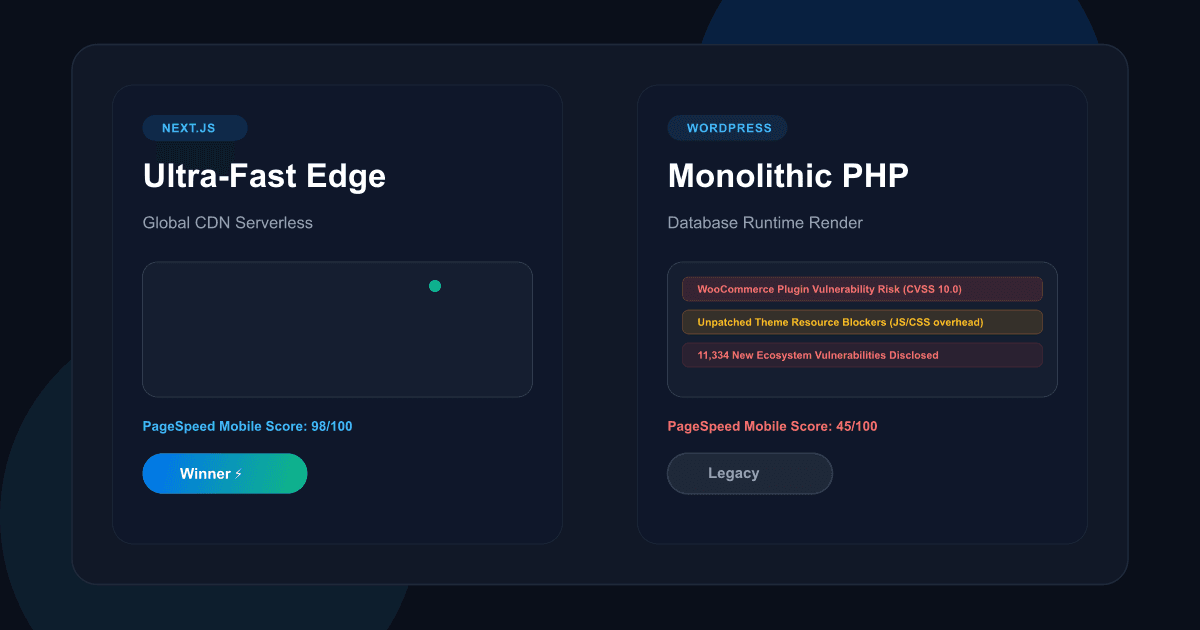
A monolithic CMS-driven architecture. When a shopper visits your store, your server runs PHP code, queries a MySQL database, assembles the page HTML, and sends it to the browser. It remains request-at-runtime at its core, creating database bottlenecks.
Pages are pre-rendered at build time (SSG) or incrementally regenerated (ISR) and served as static files from a global edge network. Database round-trips are eliminated for page loads, establishing a massive performance ceiling.
Performance & Speed Benchmarks
Page speed is no longer just a user experience issue. Since Google's Core Web Vitals became a direct ranking factor, it is a commercial issue. Faster stores rank higher, get more clicks, convert better, and retain more customers.
The WordPress performance problem has a specific cause: the plugin stack. A typical WooCommerce store runs 20–30 plugins. Each one adds JavaScript, database queries, and server overhead. By the time you layer in page builders (Elementor, Divi) and third-party tools, you carry massive weight. Next.js does not have these restrictions.
E-Commerce Security Risks
WordPress powers over 43% of all websites, making it the single largest target for automated cyber attacks. While WordPress core is robustly maintained, the vast theme and plugin ecosystem is highly vulnerable.
Under UK GDPR and PCI-DSS compliance, a data breach triggers mandatory ICO reporting, massive fines, and reputational ruin. Since Next.js has no default database running at runtime or untyped plugins, its plugin attack surface is virtually zero.
Technical & Content SEO
WordPress has a historical reputation for SEO due to easy-to-use plug-and-play meta managers. But Google's shift toward page performance as a ranking pillar is eroding that legacy.
✓ WordPress Strengths
- • Mature visual tools (Yoast, RankMath)
- • Easy custom URL structures
- • Simple category editing
✓ Next.js Strengths
- • Consistent green-range Core Web Vitals
- • Native JSON-LD and dynamic sitemaps
- • Dynamic WebP next/image optimization
- • Zero plugin conflicts or layout shifts
Content Management — The WordPress Advantage
WordPress excels in user ease. A content manager can edit descriptions, publish a blog post, or swap a homepage slider without developer assistance.
Pure Next.js requires content to reside in code, or a separate headless CMS platform like Sanity, Contentful, or Hygraph. This adds cost and complexity.
The Headless WordPress Hybrid:
You keep the familiar WordPress admin panel as your database backend, while Next.js fetches data via the WooCommerce REST API or WPGraphQL. You get the speed of Next.js combined with the ease of WordPress editing!
3-Year Total Cost of Ownership (TCO)
Platform decisions that look cheap initially often accumulate hidden costs. Here is an honest, mid-sized UK e-commerce store estimate over a three-year cycle.
| Cost Category | WooCommerce / WordPress | Next.js |
|---|---|---|
| Initial Build Cost | £3,000 – £8,000 | £6,000 – £18,000 |
| Hosting & CDN | £1,200 – £3,600/yr | £240 – £960/yr |
| Premium Plugins | £800 – £2,400/yr | £0 – £400/yr |
| Security & Firewalls | £300 – £800/yr | £0 – £200/yr |
| Developer Maintenance | £1,200 – £3,600/yr | £400 – £1,200/yr |
| Total Est. 3-Year Cost | £14,000 – £32,000 | £9,000 – £24,000 |
Scalability & Growth Fluctuations
Scalability refers to handling sudden spikes — e.g., viral Instagram mentions, national TV spots, or Black Friday traffic rushes.
WordPress WooCommerce requires vertical hosting scaling to withstand spikes, spiking your monthly bill. In contrast, Next.js deployable edge-cache servers distribute static layouts worldwide, scaling automatically without configuration.
The Verdict: Choosing By Your Stage
WordPress + WooCommerce
Revenue under £5,000/mo. Non-technical founder. Limited budget. Priority is finding product-market fit quickly.
Headless WordPress + Next.js
Revenue £5k–£50k/mo. Non-technical editorial team. Want to preserve existing WordPress investments while curing slow site speeds.
Next.js + Headless CMS
Revenue above £50,000/mo. Dedicated content/marketing teams. Global markets. UX and speed optimization are paramount.
Safe Migration: Moving Without Losing SEO Rankings
Migrating an active store is critical technical surgery. A single broken redirect can erase years of organic ranking equity in days. Here is our secure technical blueprint:
- 1
Granular URL Auditing: Map and capture 100% of your legacy page URLs (products, dynamic parameters, blogs) to maintain structure parity.
- 2
Strict 301 Redirect Mapping: Ensure any updated product path has a solid server-side 301 code to carry full SEO authority.
- 3
JSON-LD Structured Data Transfer: All product stars, FAQs, and schema parameters must compile dynamically on Next.js.
Head-To-Head Platform Summary
| Feature | Next.js | WordPress | Winner |
|---|---|---|---|
| Speed Score | 95-100 Mobile | 35-65 Mobile | Next.js ⚡ |
| Security Attacks | Virtually None | High Risk (Ecosystem) | Next.js 🔒 |
| CMS Usability | External Headless | Native Panel | WordPress 📝 |
| Build Budgets | Higher upfront | Lower entry cost | WordPress 💰 |
| Edge Scaling | Native Auto-scaling | Server Dependent | Next.js 🚀 |
Frequently Asked Questions
Is Next.js better than WordPress for SEO in 2026?+
Can I migrate from WordPress WooCommerce to Next.js without losing my SEO rankings?+
How much does a Next.js e-commerce build cost compared to WooCommerce?+
Does WordPress WooCommerce support headless commerce?+
Is WordPress dying in 2026?+
Sources & Technical References
- WordPress.org Security Report — Official guidelines on core security, vulnerability counts, and updates.
- Next.js Documentation — App Router architecture and React Server Components (RSC) optimization guidelines.
- Google PageSpeed Insights — Performance benchmarking criteria and Core Web Vitals targets.