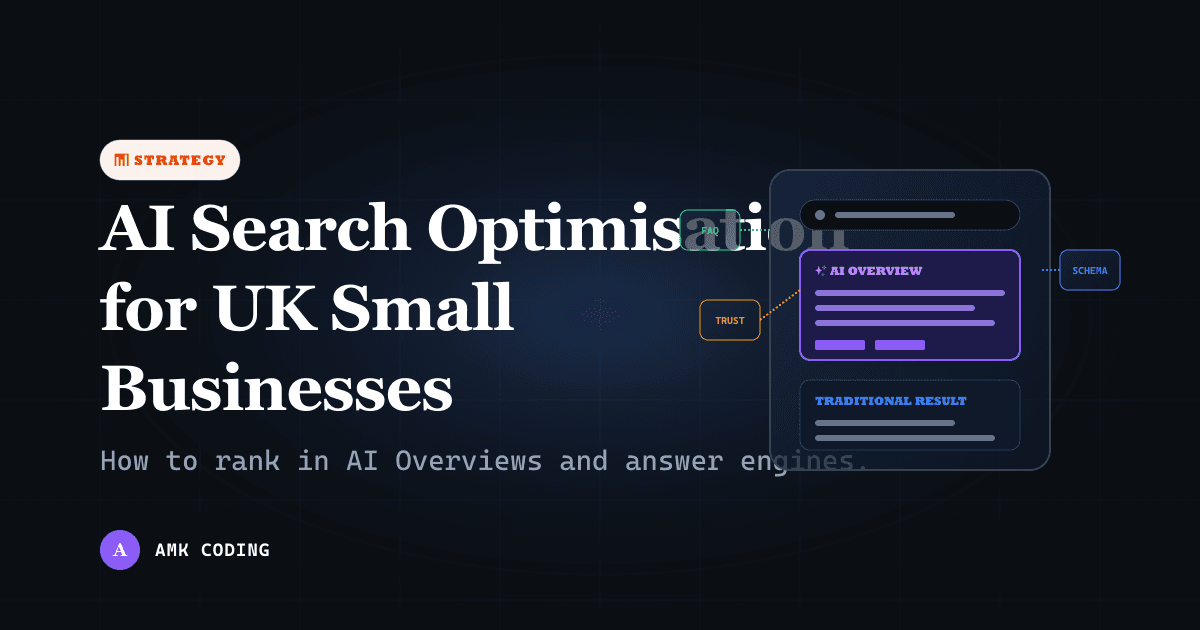
Google is changing. Customers are no longer only searching, clicking a blue link and reading one website. They are asking longer questions, comparing options inside AI-generated answers, using ChatGPT-style tools and seeing Google AI Overviews or AI Mode before traditional search results.
For UK small businesses, this does not mean SEO is dead. It means your website must become easier for search engines and AI systems to understand, trust and cite. This guide explains how to optimise your website for AI search without falling for hype, shortcuts or fake “rank in ChatGPT overnight” promises.
search results are becoming more conversational and answer-led
technical foundations still decide whether pages can be found
structured data helps machines understand your content clearly
reviews, case studies and clear business details matter more
What Is AI Search Optimisation?
AI search optimisation is the practice of making your business easier to understand, summarise and recommend inside AI-powered search experiences. You may see it called AI SEO, answer engine optimisation, generative engine optimisation, AEO or GEO. The names vary, but the goal is the same: make your website a trusted source for the questions your customers ask.
Traditional SEO asks: “Can this page rank for this keyword?” AI search adds another question: “Can a machine confidently understand this business, extract the answer, connect it to the right topic and cite it as a useful source?”
Keywords
People typed short phrases and compared pages manually.
Questions
People ask full questions and expect a direct answer, comparison or recommendation.
Machine trust
Your website must make your services, proof and expertise easy to verify.
Why AI Search Matters for UK Small Businesses in 2026
AI search is no longer a future concept. Google has official guidance for AI features such as AI Overviews and AI Mode, and these experiences can include links to supporting websites. That means your website still matters — but the way it is structured matters more.
Independent search data also shows that AI Overviews became much more visible during 2025. Coverage has moved up and down as Google tests and adjusts the feature, but the direction is clear: AI-generated search experiences are becoming part of how customers discover businesses, services and answers.
Customers ask longer questions
Instead of “web designer Brighton”, they may ask “who builds affordable SEO-ready websites for small businesses in Brighton?”
AI summarises options
Search results increasingly summarise answers, comparisons, steps and recommendations before a user clicks.
Sources need credibility
Clear service pages, real proof, reviews, author signals and structured data help your business look more reliable.
Traditional SEO vs AI Search Optimisation
AI search optimisation does not replace SEO. It expands it. If your website is slow, uncrawlable, thin, confusing or poorly structured, AI search will not fix that. The strongest approach combines traditional SEO foundations with answer-led content and structured business information.
| Traditional SEO focus | AI search focus | What to do on your website |
|---|---|---|
| Keywords | Questions, entities and intent | Write around the questions customers actually ask before buying |
| Ranking position | Being cited, summarised or used as support | Create clear answer blocks, FAQs, comparison sections and proof |
| Meta titles | Extractable page meaning | Use descriptive H1s, H2s and structured section layouts |
| Backlinks | Mentions, reputation and source credibility | Build reviews, case studies, citations, testimonials and third-party mentions |
| Service pages | Service knowledge graph | Create one clear page per service, audience and location where needed |
| Technical SEO | Machine-readable trust layer | Add schema, improve crawlability, speed, internal links and mobile UX |
How AI Search Systems Choose and Use Sources
Nobody outside the search engines can promise exactly how every AI result is selected. But public documentation and observed search behaviour point toward a practical rule: AI systems prefer content that is accessible, clear, specific, trustworthy and useful for the question being asked.
Clear answers
Pages that answer specific questions directly are easier for AI systems to summarise.
Structured information
Headings, tables, FAQs, lists and schema markup make your page easier to interpret.
Original experience
Case studies, real examples, screenshots, pricing context and first-hand insight improve usefulness.
Business credibility
Reviews, contact details, company information, author details and external mentions support trust.
Topical depth
One thin page is weaker than a connected content hub covering related questions in depth.
Crawlable technical setup
If search engines cannot crawl, render or index your pages, they cannot reliably use them.
10 Website Changes That Help with AI Search Visibility
These are practical changes small businesses can make now. They help normal SEO, local SEO and AI search visibility at the same time.
Create one clear page for every main service
Do not hide all services on one generic page. If you offer web design, landing pages, ecommerce, SEO, AI chatbots and custom platforms, each should have its own page with its own explanation, proof, FAQs and CTA.
Add FAQ sections to commercial pages
FAQs are useful because they mirror how people ask AI systems questions. Add FAQs to service pages, pricing pages, case studies and location pages. Keep answers direct, accurate and specific to your business.
Do you offer good websites? Yes, contact us.
How much does a small business website cost in the UK? Explain the range, what affects price and what is included.
Use schema markup where it actually fits
Schema does not guarantee AI visibility, but it helps search engines understand page type, organisation details, local business data, services, breadcrumbs, articles and FAQs.
Add real proof, not generic claims
“We are experts” is weak. Case studies, screenshots, before-and-after examples, client sectors, project outcomes, testimonials and process breakdowns are stronger because they show experience.
Write comparison and alternative sections
AI search often supports comparison questions. Add useful comparisons such as Next.js vs WordPress, custom website vs website builder, landing page vs homepage, AI chatbot vs contact form, or SEO vs paid ads.
- When to choose each option
- Pros and cons
- Cost ranges and trade-offs
- Best fit by business type
Make your business entity obvious
Search systems should easily understand who you are, what you do, where you serve, what your legal/trading identity is and how to contact you. Keep this consistent across your website, Google Business Profile, directories and social profiles.
Create local answer pages
Local AI search will often combine service, location and intent. Pages should answer local questions such as “who builds websites for clinics in Brighton?” or “how much does ecommerce development cost in the UK?”
This is where local SEO and AI search overlap: location-specific service pages, Google Business Profile, reviews, consistent citations and real local proof all matter.
Keep important content visible in HTML
Avoid hiding key service information inside images, scripts, sliders or decorative cards that are difficult to extract. Important headings, copy, FAQs, testimonials and service details should be readable as real page content.
Use original images, screenshots and examples
Generic stock images do not prove expertise. Use screenshots of dashboards, before-and-after website improvements, real design systems, performance audits, workflow diagrams and anonymised project examples.
For service businesses, original examples help customers and search systems understand what you actually deliver.
Refresh content when the market changes
AI search surfaces current answers. If your pricing, services, platform features, examples or technology stack change, update the page. Old content can still rank, but stale information weakens trust.
Schema Markup for AI Search Optimisation
Schema markup is not magic, and it does not force Google or AI tools to mention your business. But it does make your website easier to understand by describing the type of content and business information on the page.
| Schema type | Best used for | Why it helps |
|---|---|---|
| Organization | Company identity, logo, website and contact points | Clarifies who the business is |
| LocalBusiness | Local companies with address, service area and opening hours | Supports local search understanding |
| Service | Dedicated service pages | Helps connect the page to a specific commercial offering |
| FAQPage | Pages with genuine frequently asked questions | Makes question-and-answer content explicit |
| Article | Blog posts, guides and insights | Clarifies headline, author, date and publisher |
| BreadcrumbList | Site navigation hierarchy | Helps search engines understand where the page sits |
Bad vs Good AI Search Content
AI search punishes vague content indirectly because vague content gives systems very little to work with. The best content is specific, structured and commercially useful.
Difficult for humans and AI
- “We provide innovative digital solutions”
- No clear services or locations
- No pricing guidance or process explanation
- No FAQs answering real objections
- No case studies or proof
- No schema or clear page structure
Easy to understand and cite
- “AMK Coding builds SEO-ready websites for UK small businesses”
- One page per service and audience
- Clear process, price drivers and expected outcomes
- FAQ sections using natural customer questions
- Real case studies, screenshots and testimonials
- Schema, internal links and technical SEO foundations
Local AI Search: Why Google Business Profile Still Matters
Local businesses should not ignore traditional local SEO. AI search still needs reliable local signals: business name, address, phone number, service areas, reviews, opening hours, local pages and consistent citations.
If someone asks an AI system for “a reliable web designer near Brighton” or “a company that builds booking websites for clinics in London”, your visibility depends on how clearly the web connects your brand to that service, sector and location.
Local AI search signals to strengthen
Google Business Profile accuracy
Consistent NAP across directories
Location-specific service pages
Recent reviews and review responses
Local case studies and portfolio examples
Clear contact details and service areas
AI Search Optimisation Checklist
Use this checklist before asking whether your business is “ready for AI search”. Most improvements are not futuristic. They are the fundamentals done properly.
| Priority | Check | Why it matters |
|---|---|---|
| Critical | Your site is crawlable, indexable and fast on mobile | AI search cannot use pages that search engines cannot access properly |
| Critical | Every main service has a dedicated page | Clear service pages help machines and customers understand what you offer |
| Critical | Pages answer real customer questions directly | AI search is question-led, not just keyword-led |
| High | FAQ, Organization, LocalBusiness and Article schema are used where suitable | Structured data improves machine understanding |
| High | Reviews, case studies and testimonials are visible | Proof supports credibility and conversion |
| High | Business name, location and contact details are consistent | Consistency reduces entity confusion |
| Medium | Comparison sections answer “which is best?” questions | AI search often supports comparison-style queries |
| Medium | Content is updated when services, pricing or technology changes | Freshness matters when answers are time-sensitive |
Related AMK Coding Guides
Frequently Asked Questions
What is AI search optimisation?+
Is AI search optimisation the same as SEO?+
How do I get my website shown in Google AI Overviews?+
Can a small business appear in ChatGPT or AI search results?+
Do I still need normal SEO if AI search is growing?+
Sources and Further Reading
- Google Search Central — AI features and your website.
- Google Search Help — AI Overviews in Google Search.
- Semrush — AI Overviews impact on search in 2025.
- Semrush — SERPs with ads and AI Overviews growth in 2025.
- Google Search Central — structured data and Search appearance documentation.
Want to Know If Your Website Is Ready for AI Search?
AMK Coding can audit your website for AI search visibility, technical SEO, schema markup, service-page structure, local signals, speed and conversion issues. We will show you what is blocking your site from being understood by Google, AI Overviews and modern search systems.
AMK Coding • AI Search Optimisation • Technical SEO • Schema • Conversion-Ready Websites
AMK Coding
AMK Coding (trading as PEOPLELY LTD) is a UK web development and digital product studio. We build SEO-ready websites, landing pages, AI tools, custom platforms and conversion-focused systems for small businesses and growing companies.