“We need a developer.” It is one of the most common requests we hear from UK business owners — and one of the most expensive decisions they will make. Hire the wrong person and you lose six months and £30,000. Hire nobody and your product stagnates.
This guide compares the real costs of hiring in-house, using freelancers, and working with a dedicated development retainer — so you can make the decision with numbers, not guesswork.
What a UK developer actually costs (loaded)
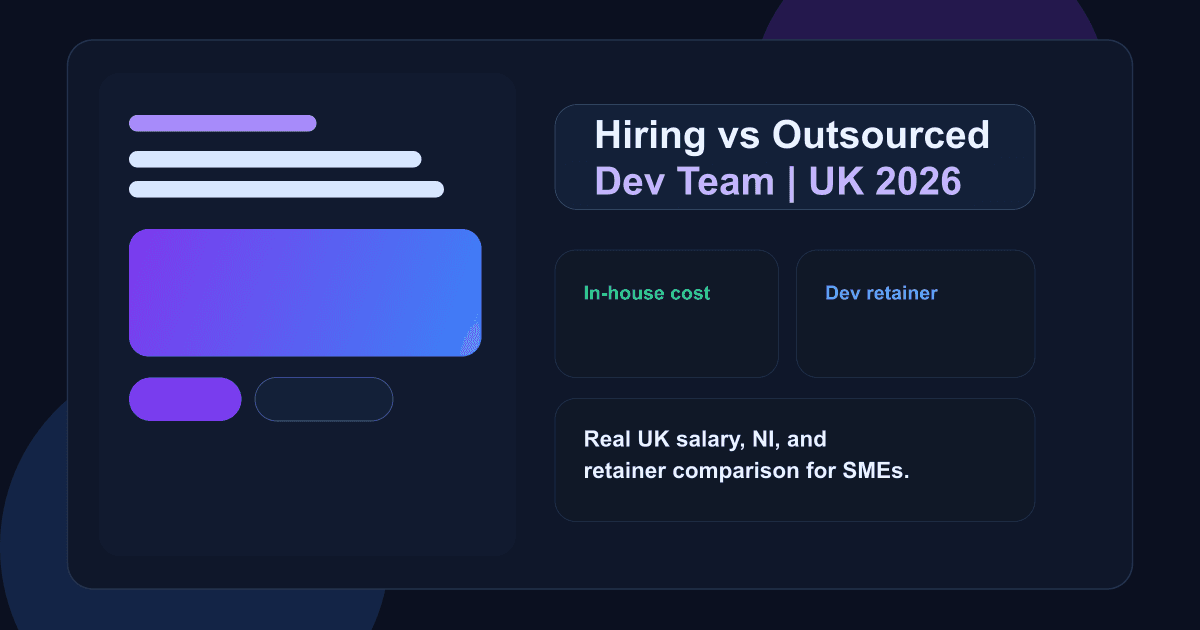
Job boards show salaries. Finance teams see loaded costs. Here is the honest breakdown for a mid-level web developer in 2026:
| Cost item | Typical annual cost |
|---|---|
| Base salary (mid-level, UK average) | £45,000 – £65,000 |
| Employer National Insurance (~15%) | £6,750 – £9,750 |
| Workplace pension (min 3% employer) | £1,350 – £1,950 |
| Recruitment (agency or time cost) | £5,000 – £15,000 (year 1) |
| Equipment, software, training | £2,000 – £4,000 |
| Loaded total (year 1) | £55,000 – £80,000+ |
London and senior roles push toward the top of this range. These figures exclude management time, holiday cover, and the risk of a bad hire.
The hidden costs nobody puts in the job ad
- Recruitment time: 8–12 weeks to hire, during which nothing gets built.
- Notice periods: 1–3 months if it does not work out — plus re-hiring cost.
- Single point of failure: One person on holiday or sick means zero dev capacity.
- Skill gaps: One hire rarely covers frontend, backend, DevOps, and security.
Freelancer vs agency retainer
Freelancer
- ✓ Lower hourly rate on paper
- ✓ Good for defined, short projects
- ✗ Continuity risk — may disappear
- ✗ No backup team or SLA
- ✗ You manage infrastructure yourself
Dedicated dev retainer
- ✓ Contract-backed continuity
- ✓ Senior team behind one contact
- ✓ Hosting, security, backups included
- ✓ Starts in 1–2 weeks, not 12
- ✗ Not 100% full-time single employee
When a retainer wins
A dev retainer makes sense when you need ongoing capacity — not a one-off website build. Typical scenarios:
- You have a SaaS product or internal tool that needs continuous feature work.
- You tried hiring but the recruitment cycle took too long or the hire did not work out.
- You need senior skills (Next.js, Stripe, Supabase) your team lacks.
- You want predictable monthly cost instead of surprise project quotes.
When to hire in-house instead
Hiring is the right call when development is your core business and you need someone available 40 hours a week, in the office, embedded in every meeting. If your product is the company — not a supporting tool — a full-time hire may justify the overhead.
For most UK SMEs running a business with a website, e-commerce store, or internal platform, a retainer delivers more senior capacity per pound and starts faster.
AMK Dedicated Development
We offer three retainer tiers from £1,500/month — senior UK developers, hosting and security included, annual contracts with 10–15% saving. No recruitment, no NI, no notice periods.
Frequently asked questions
How much does it cost to hire a developer in the UK in 2026?
A mid-level UK web developer typically earns £45,000–£65,000 base salary. Once you add employer National Insurance (~15%), workplace pension (minimum 3%), recruitment fees (£5,000–£15,000), equipment, and management time, the loaded cost is usually £55,000–£80,000 per year. Senior developers and London-based roles push higher.
Is a dev retainer cheaper than hiring in-house?
For many SMEs, yes. A Dedicated Dev retainer from £3,500/month (£42,000/year) gives you senior capacity without recruitment, NI, pension, or notice-period risk. You do not get a full-time single employee, but you get predictable access to senior developers who can ship roadmap work, fix bugs, and manage infrastructure.
When should I hire in-house instead of outsourcing?
Hire in-house when you need someone physically present daily, deeply embedded in company culture, available for ad-hoc tasks across the business, or when dev work is your core product and you need 100% of someone's time indefinitely. For most SMEs needing a website, internal tool, or ongoing product work, a retainer is faster to start and lower risk.
What is the risk of hiring a freelancer instead?
Freelancers can be excellent for defined projects, but continuity is the risk — they may disappear mid-project, become unavailable when you need them, or lack depth in your stack. There is no SLA, no backup team, and no infrastructure management. A retainer from an agency gives you contract-backed continuity and a team behind one developer.
How quickly can I start with a dev retainer?
Most retainers can begin within 1–2 weeks of signing — no 8–12 week recruitment cycle. Onboarding includes repo access, environment setup, and an initial audit of your existing codebase if applicable.