You've invested in CQC registration, built a clinical team, and found premises. Then you built — or paid someone to build — a website. It looks fine. Professional, even. But the phone isn't ringing the way it should, and your booking system sits quiet most evenings.
This is the invisible problem facing hundreds of private clinics across London right now. The website exists. But it is not working.
In a market where patients are searching Google for "private GP London" or "private dermatologist near me" every day, the difference between a clinic that grows consistently and one that plateaus almost always comes down to one thing: conversion-focused web design.
Below are the seven elements we implement on every clinic website we build at AMK Coding — the same elements that turn passive visitors into booked patients.
of visitors to the average healthcare website leave without taking any action. Conversion rate optimisation is the most cost-effective growth lever available to private clinics.
In This Design Guide:
Above-the-Fold Booking CTA — Not a Phone Number
The single most important piece of real estate on your website is the section visible without scrolling — what designers call "above the fold." Most clinic websites bury this with a hero image, a tagline, and a phone number in the top-right corner.
That approach was built for 2010. Today, over 70% of local healthcare searches happen on mobile devices, where users expect to complete tasks in seconds. When they land on your site, they are not looking to call — they are looking to book.
A high-converting above-the-fold section for a private clinic should include:
- A primary H1 headline that names your specialty and location explicitly (e.g. "Private GP Appointments in Central London — Same-Week Availability")
- A single prominent "Book an Appointment" button — high contrast, above centre on mobile
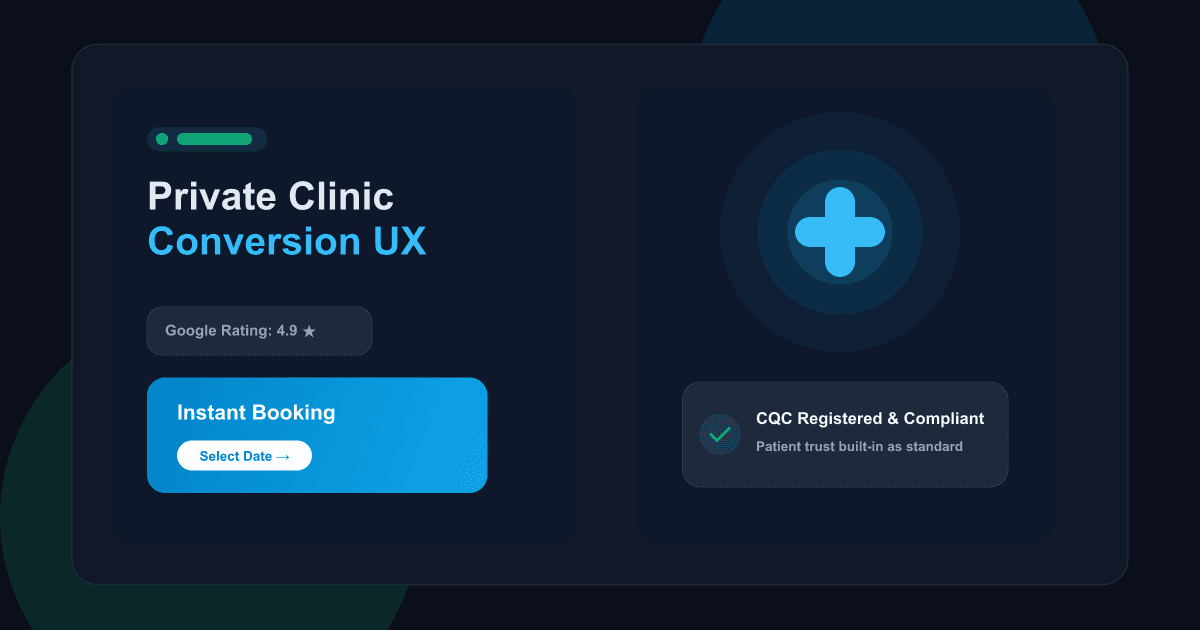
- A one-line trust reinforcement directly under the button: "CQC Registered · GMC-Certified Doctors · No Referral Needed"
- A short response-time indicator: "Most appointments available within 48 hours"
Real-world result: One physical therapy practice redesigned their homepage CTA section and saw a 203% increase in conversion rate — without changing their ad spend or traffic volume. The only change was making the booking action immediately obvious.
Trust Signals: CQC Registration, GMC Numbers, and Patient Testimonials
Healthcare is the highest-trust purchase most people ever make. Unlike buying a pair of trainers, choosing a private clinic involves vulnerability, medical risk, and significant personal expenditure. Your website needs to work exceptionally hard to signal legitimacy.
Google classifies healthcare websites as YMYL (Your Money Your Life) content — a category that receives heightened scrutiny from both human quality raters and algorithmic signals. Poor E-E-A-T (Experience, Expertise, Authoritativeness, Trustworthiness) signals do not just cost you patient bookings — they cost you Google rankings.
What to display prominently:
- CQC registration badge with your registration number and a link to your CQC profile — place this in the footer and on your About page
- Individual GMC / NMC registration numbers for each practitioner on their bio page
- Named doctor profiles with professional headshots, qualifications, years of experience, and subspecialties
- Patient testimonials with first name and treatment type — anonymised but specific
- Google Reviews widget embedded on the homepage or a dedicated Reviews page
- Professional memberships: BUPA recognised, AXA Health recognised, medical defence body membership (MDU/MPS)
Important: Purely cosmetic clinics offering only Botox or dermal fillers for appearance may not require CQC registration. However, any clinic providing treatment of disease, disorder or injury, diagnostic procedures, or surgical procedures is legally required to register with the CQC under the Health and Social Care Act 2008. Displaying your registration status prominently is both a legal best practice and a powerful trust signal.
Mobile-First Design Built for One-Thumb Navigation
When we talk about mobile-first design, we do not mean "the desktop site shrinks on mobile." We mean the mobile experience is designed first — and then expanded for larger screens.
Consider the journey of a typical London clinic patient. They feel unwell on their commute. They search "private doctor London" on their phone during their lunch break. They have 90 seconds and one free thumb. If your website makes them pinch-zoom, wait for a slow load, or hunt for a booking button — they're on the next result.
of consumers are less likely to convert if they have a negative mobile experience. For healthcare providers, this translates directly to lost patient bookings every single day.
Non-negotiable mobile performance requirements:
| Metric | Target | Why It Matters |
|---|---|---|
| Largest Contentful Paint (LCP) | Under 2.5s | Google Core Web Vital — directly affects search ranking |
| Cumulative Layout Shift (CLS) | Under 0.1 | Prevents content jumping as page loads — hugely damaging on mobile |
| Interaction to Next Paint (INP) | Under 200ms | Responsiveness of buttons and forms — critical for booking flow |
| Tap target minimum size | 44×44px | WCAG AA accessibility — prevents misclicks on small devices |
| Font size (body text) | Minimum 16px | Prevents browser auto-zoom on iOS which breaks form layouts |
We build clinic websites using our premium Next.js Web Application services — delivering near-perfect Core Web Vitals scores out of the box through server-side rendering, image optimisation, and edge caching. This is a measurable competitive advantage in local search rankings.
Service Pages Structured for SEO and YMYL Compliance
Most clinic websites have a "Services" page with a bulleted list. This is a missed opportunity on two fronts: it provides almost no SEO value, and it fails to address the patient's specific anxieties and questions about that treatment.
Each core service you offer should have its own dedicated page — and that page should be built with both Google's E-E-A-T framework and patient psychology in mind.
The anatomy of a high-performing clinic service page:
- Keyword-rich H1 — "Private Dermatology Consultation in London" not "Dermatology Services"
- What the service is — plain English, no jargon. Answer: "Is this what I need?"
- What to expect — step-by-step process from booking to post-appointment. Reduces anxiety and pre-empts the most common enquiry calls
- Who performs it — named clinician with credentials linked to their bio page
- Pricing information — even a "from £X" range builds trust; hiding prices causes drop-off
- Patient testimonials specific to that service — not generic reviews
- Booking CTA — repeated at top and bottom of the page
- FAQ section — target long-tail search queries ("Does private dermatology require a GP referral?", "How quickly can I get a private dermatology appointment in London?")
SEO note: Individual service pages also act as independent landing pages that can rank for specific searches. A single well-written "Private Smear Test London" page can generate a consistent stream of bookings entirely from organic search — with zero ongoing advertising cost.
"A clinic website is not a brochure. It is a 24/7 patient acquisition system — and every page either earns its place or loses you money."
Patient Journey Page Flow — Designed to Reduce Drop-Off
Even with excellent individual pages, clinics lose bookings at the transitions between pages. A patient reads your homepage, clicks through to a service, and then what? If the path from interest to booked appointment has any friction — a slow page, a confusing navigation, a form that asks too many questions — you lose them.
The optimised patient journey for a private clinic website is:
- Landing page / Homepage — establishes trust, shows your specialties, presents a clear CTA
- Service page — specific information about the treatment they need, builds confidence
- Clinician bio — the human face they will be trusting with their health
- Booking/contact page — minimum fields: name, email, phone, preferred service, preferred date. Nothing else.
- Confirmation page — reassurance, what happens next, add-to-calendar option
Every page in this journey needs a visible "Book Now" button — not just on the homepage. And that button should always be accessible from the navigation bar, regardless of where the patient is in your site.
Booking forms are another common failure point. Patients abandoning forms is one of the most common and most preventable sources of lost bookings. Keep your initial enquiry form to five fields maximum. Collect clinical information after the booking is confirmed, not before.
Schema Markup for Medical Practices — The Technical SEO Advantage
Schema markup is structured data embedded in your website's code that tells Google exactly what your business is, who works there, what services you offer, and how to contact you. For local healthcare businesses, this is one of the highest-leverage technical SEO investments available.
Correctly implemented schema can unlock rich results in Google Search — displaying your clinic's opening hours, star rating, location, and even available services directly in the search results page, before the patient even clicks through. This increases both click-through rates and the quality of patients who do visit your site.
Key schema types for private clinics:
- MedicalOrganization or Physician — identifies your entity as a healthcare business
- LocalBusiness — captures address, phone, opening hours, geographic area served
- MedicalSpecialty — tags your specific specialisms (Dermatology, General Practice, etc.)
- FAQPage — marks up FAQ sections to appear as expandable rich results in Google
- Review / AggregateRating — pulls in your star rating alongside search results
- BreadcrumbList — improves navigation context in search results
Here is a minimal example of the MedicalOrganization schema for a London clinic:
{
  "@context": "https://schema.org",
  "@type": "MedicalOrganization",
  "name": "[Your Clinic Name]",
  "url": "https://yourclinic.co.uk",
  "telephone": "+44-20-XXXX-XXXX",
  "address": {
    "@type": "PostalAddress",
    "streetAddress": "123 Harley Street",
    "addressLocality": "London",
    "postalCode": "W1G 6AX",
    "addressCountry": "GB"
  },
  "medicalSpecialty": "Dermatology",
  "openingHoursSpecification": [{
    "@type": "OpeningHoursSpecification",
    "dayOfWeek": ["Monday", "Tuesday", "Wednesday", "Thursday", "Friday"],
    "opens": "08:30",
    "closes": "18:00"
  }]
}GDPR-Compliant Contact Forms and Cookie Consent
This element is last in our list but it is far from optional — particularly for healthcare providers where the data involved is classified as Special Category Data under UK GDPR. Getting this wrong is not just a trust issue. It is a legal and regulatory risk that can result in ICO enforcement action.
What your clinic website must have:
- Cookie consent banner — must be granular (not just "Accept All"). Necessary, Analytics, Marketing. Cannot be pre-ticked. Must be as easy to refuse as to accept.
- Privacy policy page — must specifically reference how healthcare enquiry data is processed, stored, and who it is shared with (e.g. booking system providers)
- Explicit consent checkbox on contact forms — "I consent to [Clinic Name] contacting me about my enquiry" with a link to your Privacy Policy
- Secure form submission (HTTPS) — non-negotiable. HTTPS is also a direct Google ranking signal.
- Data retention policy — how long do you keep enquiry data? 6 months is a reasonable default for non-patient contact forms.
Trust bonus: Counterintuitively, a professionally implemented cookie consent setup and visible privacy policy actually increases patient trust. It signals that your practice takes confidentiality seriously — which is exactly what patients want to see from a healthcare provider before sharing their medical concerns.
We implement cookie consent via a GDPR-compliant solution on every clinic website we build, with granular consent categories pre-configured for healthcare businesses. This is included as standard — it is not an optional extra.
The 7-Element Checklist: Is Your Clinic Website Conversion-Ready?
Use this quick audit to score your current website. Each item below is either working for you or costing you bookings:
| # | Element | Quick Test | Impact |
|---|---|---|---|
| 1 | Above-fold booking CTA | Is "Book Now" visible without scrolling on mobile? | ★★★★★ |
| 2 | Trust signals | Is your CQC number visible on the homepage? | ★★★★☆ |
| 3 | Mobile-first design | Does your site score 90+ on Google PageSpeed (mobile)? | ★★★★★ |
| 4 | Individual service pages | Does each service have its own dedicated URL and page? | ★★★★☆ |
| 5 | Patient journey flow | Can a visitor book in under 3 clicks from any page? | ★★★★☆ |
| 6 | Schema markup | Does Google Search Console show rich result eligibility? | ★★★☆☆ |
| 7 | GDPR compliance | Is your cookie consent granular and easy to decline? | ★★★☆☆ |
If you answered "no" to three or more of the above — your website is likely costing you between 5 and 15 bookings per month that you are not seeing. In a London private clinic with an average consultation value of £150–£400, that is a significant and preventable revenue gap.
Ready to Turn Your Website Into a Patient Acquisition Engine?
We specialize in custom medical practice web design — combining GMC/CQC compliance, lightning-fast Next.js performance, and seamless booking system integrations. Let's talk about your clinic in a free consultation.
AMK Coding · CQC & GDPR compliant design · GP & Clinic web specialists serving London
Sources & Medical Guidelines
- Care Quality Commission (CQC) — Official standards for medical provider registration and digital trust badges in the UK.
- General Medical Council (GMC) — Professional ethics guidelines on digital credentials and publication of clinician information.
- Information Commissioner's Office (ICO) — GDPR guidelines on processing Special Category medical data through online contact forms.